

Because I’m Called Out
A Message for the Holidays

Feel free to skip the following lengthy passages and just read the article. But the scripture is relevant to the topic today so also feel free to read and glean from them.
May these words bless you today, Shalom.
“And to the sovereign of Judah, who sent you to inquire of Yahweh, say this to him, ‘Thus said Yahweh Elohim of Israel, “As for the words which you have heard, because your heart was tender, and you humbled yourself before Yahweh when you heard what I spoke against this place and against its inhabitants, that they would become a ruin and a curse, and did tare your garments and wept before Me, I also have heard,” declares Yahweh. “Therefore, see, I am gathering you to your fathers, and you shall be gathered to your burial-site in peace, so that your eyes do not see all the evil I am bringing on this place.” ’ “ And they brought word to the sovereign.”
2 Kings 22:18-20 TS2009
“And the sovereign sent, and they gathered all the elders of Judah and Jerusalem to him. And the sovereign went up to the House of Yahweh with all the men of Judah, and all the inhabitants of Jerusalem with him, and the priests and the prophets and all the people, both small and great. And he read in their hearing all the words of the Book of the Covenant which had been found in the House of Yahweh. And the sovereign stood by the column and made a covenant before Yahweh, to follow Yahweh and to guard His commands and His witnesses and His laws, with all his heart and all his being, to establish the words of this covenant that were written in this book. And all the people stood to the covenant. Then the sovereign commanded Hilqiyah the high priest, and the priests of the second order, and the doorkeepers, to bring out of the Hĕḵal of Yahweh all the objects that were made for Ba‛al, and for Ashĕrah, and for all the host of the heavens. And he burned them outside Jerusalem in the fields of Qiḏron, and took their ashes to Bĕyth Ěl. And he put down the black-robed priests whom the sovereigns of Judah had appointed to burn incense on the high places in the cities of Judah and in the places all around Jerusalem, and those who burned incense to Ba‛al, to the sun, and to the moon, and to the constellations, and to all the host of the heavens. And he brought out the Ashĕrah from the House of Yahweh, to the wadi Qiḏron outside Jerusalem, and burned it at the wadi Qiḏron and ground it to ashes, and threw its ashes on the burial-sites of the sons of the people. And he broke down the houses of the male cult prostitutes that were in the House of Yahweh, where the women wove tapestries for the Ashĕrah. And he brought all the priests from the cities of Yehuḏah, and defiled the high places where the priests had burned incense, from Geḇa to Be’ĕrsheḇa, and broke down the high places at the gates which were at the entrance of the Gate of Joshua the governor of the city, which were to the left of the city gate. However, the priests of the high places did not come up to the slaughter-place of Yahweh in Jerusalem, but they ate unleavened bread among their brothers. And he defiled Topheth, which is in the Valley of the Son of Hinnom, so that no man could make his son or his daughter pass through the fire to Moleḵ. And he did away with the horses that the sovereigns of Judah had given to the sun, at the entrance to the House of Yahweh, by the room of Nathan-Meleḵ the eunuch, that were in the court. And he burned the chariots of the sun with fire. And the slaughter-places that were on the roof of the upper room of Aḥaz, which the sovereigns of Judah had made, and the slaughter-places which Menashsheh had made in the two courtyards of the House of Yahweh, the sovereign broke down, and rushed from there, and threw their dust into the wadi Qiḏron. And the sovereign defiled the high places that were before Jerusalem, which were on the right hand of the Mountain of Destruction, which Shelomoh sovereign of Israel built for Ashtoreth the abomination of the Tsiḏonians, and for Kemosh the abomination of the Mo’aḇites, and for Milkom the abomination of the children of Ammon. And he broke in pieces the pillars and cut down the Ashĕrim, and filled their places with the bones of men. And also the slaughter-place that was at Bĕyth Ěl, and the high place which Jereboam son of Neḇat made, by which he made Israel sin, both that slaughter-place and the high place he broke down. And he burned the high place and ground it to dust, and burned the Ashĕrah. Then Josiah turned, and saw the burial-sites that were there on the mountain. And he sent and took the bones out of the burial-sites and burned them on the slaughter-place, and defiled it according to the word of Yahweh which the man of Elohim proclaimed, who proclaimed these words. And he said, “What tombstone is this that I see?” And the men of the city said to him, “It is the burial-site of the man of Elohim who came from Judah and proclaimed these matters which you have done against the slaughter-place of Bĕyth Ěl.” And he said, “Let him alone, let no one move his bones.” So they left his bones alone, with the bones of the prophet who came from Shomeron. And Josiah also took away all the houses of the high places that were in the cities of Shomeron, which the sovereigns of Israel had made to provoke. And he did to them according to all the deeds he did in Bĕyth Ěl. And he slaughtered all the priests of the high places who were there, on the slaughter-places, and burned men’s bones on them, and went back to Yerushalayim. And the sovereign commanded all the people, saying, “Prepare the Passover to Yahweh your Elohim, as it is written in this Book of the Covenant.” For such a Passover had not been prepared since the days of the rulers who ruled Israel, nor in all the days of the sovereigns of Israel and the sovereigns of Judah, but in the eighteenth year of Sovereign Josiah this Passover was prepared before Yahweh in Jerusalem. And also, Josiah put away those who consulted mediums and spiritists, and the household mighty ones and idols, and all the abominations that were seen in the land of Judah and in Jerusalem, in order to establish the words of the Torah which were written in the book that Hilqiyah the priest found in the House of Yahweh. And before him there was no sovereign like him, who turned back to Yahweh with all his heart, and with all his being, and with all his might, according to all the Torah of Moses; and after him none rose up like him.”
2 Kings 23:1-25 TS2009
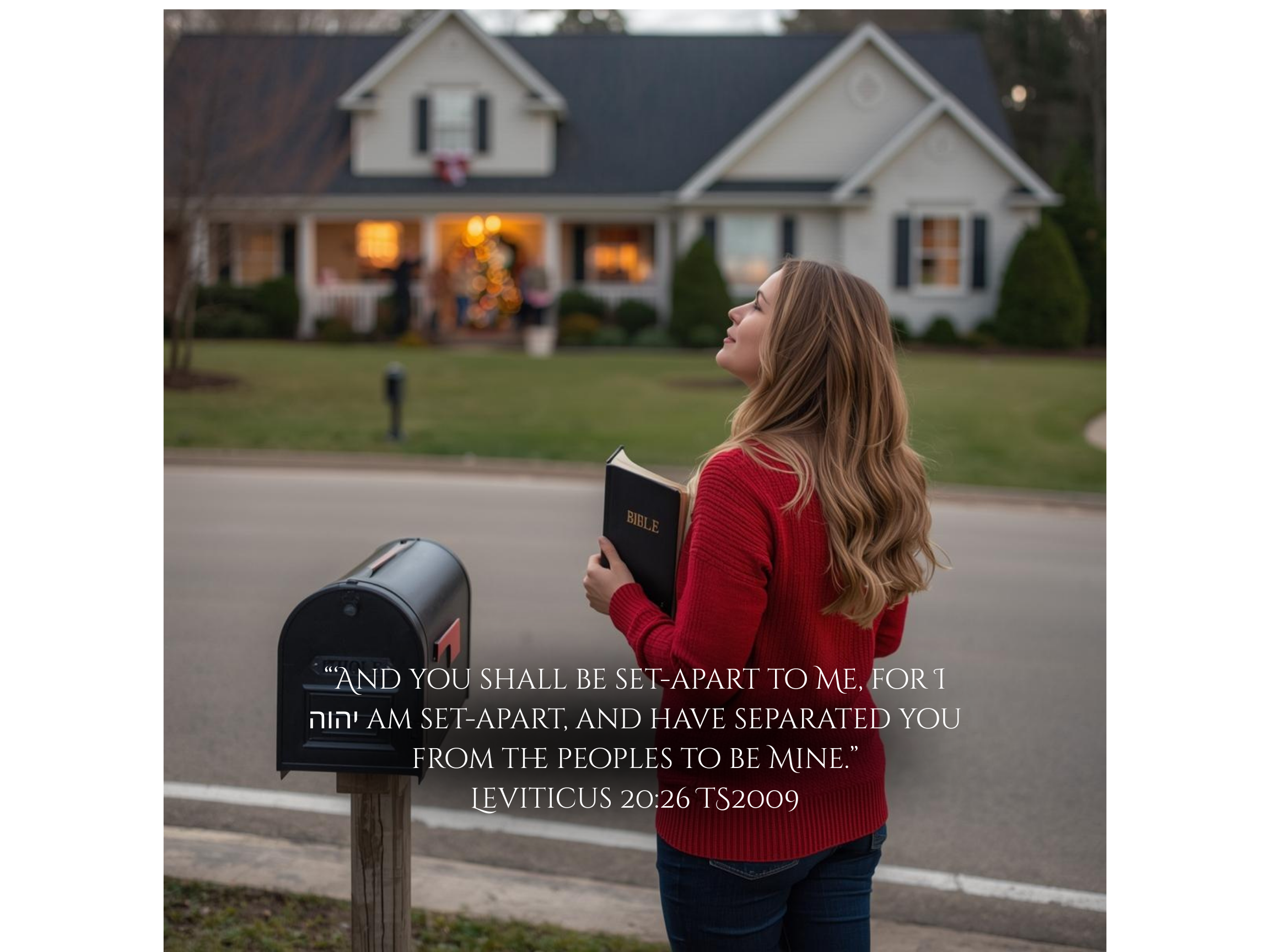
Called Out
Hello Lovely Readers,
I wanted to share a message today as the holiday season continues to get closer.
Maybe you are a newcomer to Torah, or maybe you have never touched it. Maybe you love Christmas and could never imagine giving it up. Or maybe you have already put away Christmas and other holidays for some time, but this year is harder than others, and you are wondering what it may be like to go back to doing those things.
It can be hard, cutting ties with all you grew up with. You feel like you aren’t as righteous as Abraham. Maybe you feel more like Rachel when Jacob led his family out of Laban’s house. Or Lot’s wife, temped to go back. Everyone goes through a unique journey when it comes to following God as He progressively draws us closer and closer to Himself. But we all know, it isn’t easy. Even some people in Israel wanted to go back to Egypt, and others never left Babylon.
As I have been wrestling with my own confusing season, peeking back at what I’ve left behind, I’m reminded of this:
God brought us out of Egypt. He brought His people out of Babylon. And He told them to disregard the ways of those lands, and live unto Him. And even when they were in the land of Canaan, He instructed His people not to bend their knees to the ways of the land. This is what we are called to do as believers. To live unto Him. To live our lives set-apart and unique to the world. We are called out of the darkness and into the Light.
We are not meant to continue in the ways of the world. To do what is common. Nor are we meant to place God’s name on things that are not of Him.
When Josiah found the Torah, he lamented the people had lost His ways. They had strayed far away from the ways of the Lord. Once Josiah was made aware of the Torah, he turned his entire country around. He completely destroyed and abolished any trace of abomination in the land. He removed everything that dishonored the Lord. He removed everything that was involved with the worship of other deities in order to redeem his people back to the worship of Yahweh.
There are other kings in scripture who were said to follow Yahweh themselves, but they did not get rid of the Asherim. They did not cleanse their country. They left the abominable things alone.
But Josiah, he knew these things were abominable to the Lord. And he got rid of them. No matter the cultural norm. No matter the emotional ties. He recognized God’s ways did not involve these practices in any way, and he made them an abomination to his country.
Because Josiah was promised a peaceful death, and the rest judgement, the text implies Josiah may have been the only one whose heart was moved purely towards God when he discovered the Torah. The people still were punished for their neglect of His ways. Josiah was the only one spared of judgment, because he recognized and did all he could to rectify the wrong, and turn towards the right to every possible extent, and his heart was fully turned towards God.
“He knows my heart”
I am reminded by the conversation taking place next to me at a coffee shop that Yeshua said that in the last days he would say “depart from me, you workers of lawlessness, for I never knew you.”
Lawlessness is without and against the law.
Many will cry “Lord, Lord” and yet he will still say, “depart”.
“If you love me, keep my commands”
Both Yahweh and Yeshua said this.
Is it love to stay in the ways of the world, the ways of other religions, without seeing a need in our hearts to neglect those ways? Is it love to say that that which God called an act of love, as an act of bondage? Is it love to keep abominable things in our midst, and call what God called sin, good?
If we cannot give up all things of the world, in order to worship God purely in the ways He desired for His people to worship Him, what does that say about our heart?
Josiah threw it all away and was blessed. The people didn’t change their hearts, and they fell under judgement.
Today, people are still following after the heart of flesh. The idea of doing what God wants is not only believed but preached as abominable. In the very church I grew up in, the feasts of the Lord were categorized under the ways of the world, and the festivals the world does were categorized as God’s true ways. Is this righteous? What is God going to recognize as love for Him?
People in scripture partook in rituals as deep as child sacrifice and sexual atrocities in God’s own temple. They put His name on something abhorrent to Him. He even condemned them, saying He never required that of His people. “But God sees my heart” they may say, as they burn a child up to Him. Yes. He does see your heart. He sees where it truly holds fast. Not in His ways, but in your own, and that of other false deities.
God set forth His ways. And He separated them from the ways of the world. And He desires that His people choose Him, above all else. He brought people like Abraham out of their land, their family, everything familiar. He allowed people like Job to be stripped of all he loved, to test his true heart for Him. And they both chose to follow God, regardless of emotional ties and cultural norms, even though it resulted in losing everything they had on this earth.
We are meant to be a light unto the nations, not a friend to the nations. We are not meant to be at peace with the practices that honor other false gods. We are meant to live in God’s ways, and encourage others to do the same.
When Yisra’el was in the wilderness, they decided to worship God as they had learned to in Egypt. And were they not condemned? “But you know my heart God!” Would they have cried? Just because the name of God or Jesus is associated with an act of idolatry does not make it righteous unto Him. It is an abomination.
And Josiah recognized this whole heartedly.
I Left Egypt
When my family realized the truth, we radically changed our lives. We removed the Asherah tree in the shed. We removed every movie and book that held and “innocently” taught witchcraft. We removed the anks on our walls. We removed ourselves from festivals dedicated to the Devil. We removed ourselves from festivals which continue to observe the rites and rituals of ancient pagan religions. We removed ourselves from a church which taught directly against the Word of Yahweh.
We left Egypt.
And we are not going back.
I am not going back.
I want to honor my Father in Heaven in the way that He feels most honored. In the way He conveyed time and time again for thousands of years that He wants to be worshiped, apart from the ways of the nations.
“And the works of the flesh are well-known, which are these: adultery, whoring, uncleanness, indecency, idolatry, drug sorcery, hatred, quarrels, jealousies, fits of rage, selfish ambitions, dissensions, factions, envy, murders, drunkenness, wild parties, and the like – of which I forewarn you, even as I also said before, that those who practise such as these shall not inherit the reign of Elohim. But the fruit of the Spirit is love, joy, peace, patience, kindness, goodness, trustworthiness, gentleness, self-control. Against such there is no Torah.”
Galatiyim (Galatians) 5:19-23 TS2009
I forgot 5:18.
“But if you are led by the Spirit, you are not under Torah.”
Or rather, you are not beneath Torah. It is not above you to do the works of the Lord. The works which result in the fruits of the spirit which come from acting in contradiction to the works of the flesh. Practicing what is the opposite of sin is not bondage. It is righteousness that produces the fruit of the spirit.
But you have to choose.
Flesh or Spirit?
Egypt or God’s Kingdom?
Where is your heart?
Is your heart emotionally tied to the practices of the world? Or is your being tied to Yahweh and desire to live unto Him as HE desires to be honored?
Message of the Day
Yeshua told the desciples to leave EVERYTHING to follow him as he taught the ways of his Father.
Are you willing to leave EVERYTHING behind? Including your love feasts?
I did.
Living still in the midst of the world, it isn’t always easy. In recent days, I have been wondering what it would be like to go back to Egypt. The world, and even close friends, make it so tempting. But I know that would not honor God. He brought me out.
There’s always respect for the journey. This message is not meant to throw stones, but to shine light. It took my family over the course of a decade to fully commit and realize it was time to let go of everything. But once we decided to commit, we were all in. We left everything behind. Friends, family, traditions. In order to pursue a life honorable to the Most High.
So what about you?
Who is your God? And do you honor Him in all that you do, or do you let your flesh rule seasonally?
If Yahweh has delivered you from Egypt, don’t turn back. Hold fast to what you know is true. We will be rewarded for our endurance.
And if you are wondering if you should take that next step, take it in good faith, knowing it is more important to honor God than to please people.
Shalom in this season,
— Alexis
Good word and reminder. I especially like your interpretation of Galatians 5:18: We are not beneath obeying the Torah.